Colonel Stanton's Visit to the Ruthven Home
Young Captain Jack · The Son of a SoldierColonel Stanton's Visit to the Ruthven Home is a decisive wartime encounter in which military occupation becomes a scene of ethical recognition and hidden-family revelation. After Federal troops camp near the Ruthven home, Colonel Stanton's conduct distinguishes disciplined authority from the predatory violence of guerrillas, while his meeting with Alice Ruthven begins to dismantle her inherited image of Federal soldiers as brutes. The visit also brings Harry Powell back into the household and places Stanton's resemblance to Jack Ruthven, his fevered references to Laura and a son named Jack, and the documentary evidence from the Nautilus wreck on a converging path toward the truth.
Causes and Wartime Background
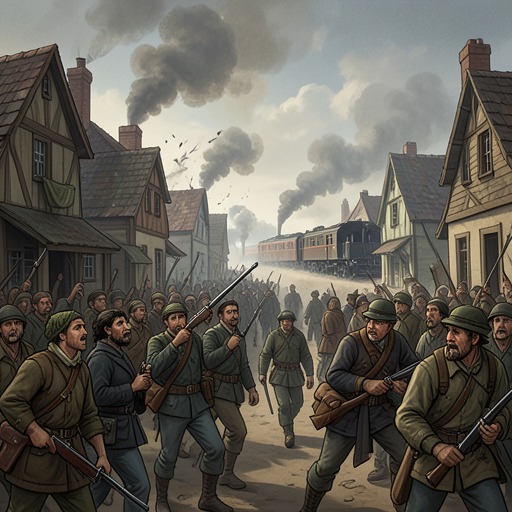
The visit occurs after a Federal regiment establishes camp a short distance from the Ruthven home. The neighborhood initially reacts with alarm, but Colonel Stanton's reputation as a strict disciplinarian quickly changes the practical meaning of the occupation: he does not permit pilfering, and the inhabitants become less fearful. This restraint is especially important because the plantation is not merely a private residence. It has become a hospital holding six wounded Confederates under the care of a surgeon, so the house occupies a morally sensitive space between civilian property and military necessity.
The contrast with the guerrillas who earlier approached the homestead is sharp. Those irregular fighters are described as men who follow armies for the sake of looting afterward, and they threaten the house despite Jack's insistence that private property must be respected and that the wounded men inside require protection. Stanton's arrival therefore introduces a competing model of wartime power. Where the guerrillas treat proximity to an army as an opportunity for plunder, Stanton treats discipline, civilian safety, and the hospital's function as obligations.
The Meeting with Old Ben and Harry Powell
On the day after the Federal troops arrive, Old Ben encounters Colonel Stanton on the road to the Ruthven mansion. Stanton is accompanied by Harry Powell, now a surgeon in Federal uniform and changed in appearance by a heavy mustache. Old Ben does not immediately recognize Powell, whose return links the visiting army to the Ruthven family: he is Alice Ruthven's nephew, had lived in Philadelphia, opposed slavery, and joined the Federal troops when the war began, to the distress of his Southern relatives.
Jack Ruthven recognizes Powell at once and reacts with shock at seeing a familiar family connection presented in the uniform of the opposing army. Powell answers Jack's objection by asking whether they can meet not as Yankee and Southerner but as cousins. Jack's affection overcomes his political resistance, and the two shake hands warmly. The gesture does more than restore a personal bond. It gives the visit an intimate human scale and demonstrates how the war has placed family loyalty and national allegiance in direct conflict without wholly destroying either.
Colonel Stanton likewise refuses the caricature that Jack has absorbed from wartime rumor. When Jack admits that he had thought all Yankees were brutes, Stanton's manner is so pleasant that Jack feels drawn to him. Powell assures Jack that Alice need not fear the Federal soldiers, and Stanton confirms the assurance. In this first contact, Stanton is not introduced through battlefield triumph but through composure, courtesy, and a willingness to let conduct answer prejudice.
Stanton and Alice Ruthven at the Mansion
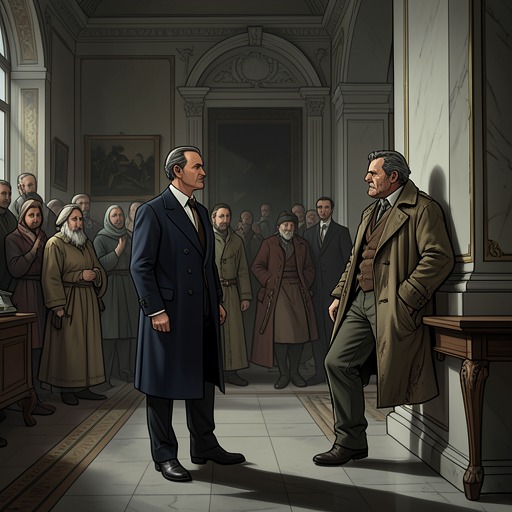
Alice Ruthven approaches Harry Powell with tears in her eyes after their long separation, yet his uniform makes the reunion painful. Powell postpones the political argument and formally introduces Colonel Stanton. Alice recognizes in Stanton a man of breeding and courtesy, but she still declares that she is a Southern woman. Her hesitation registers the larger division of the war inside a domestic room: welcome is offered by courtesy, while allegiance and fear make complete ease impossible.
Alice asks whether the household is to be considered a group of prisoners of war. Stanton firmly denies this and identifies the mansion's hospital function as the reason it should remain undisturbed. His answer protects the house without pretending that the surrounding military situation has vanished. When Alice explains that stories of violence and rapine have made her apprehensive, Stanton rejects those stories as generally baseless and insists that a true soldier, whatever banner he serves, respects a lady and would not injure or annoy her. He refuses to present himself as an isolated exception, arguing instead that honor and humanity belong to many of his fellow officers as well.
This exchange changes Alice's understanding of the opposing army through a concrete encounter rather than an abstract political debate. She remains a Southern woman, but Stanton's behavior makes that identity compatible with acknowledging Federal honor. The mansion thus becomes a meeting place where the war's public antagonism is tested against private conduct, and where protection of the wounded provides a practical basis for restraint across enemy lines.
Buried Clues and the Shipwreck Memory
The visit's immediate subject is military occupation, but its deeper narrative function is investigative. Jack's history has already been tied to the wreck on Hemlock Bluff rocks: he was a child passenger when the ship came ashore, and Old Ben found him on the beach beside his injured mother. Jack retains only a dreamlike memory of the storm and terrible waves. The evidence preserved from that disaster includes his mother's unmarked clothing, a lace handkerchief, and a ring whose worn marking could not be read even by jewelers. Alice keeps these objects, and the small ring and delicate handkerchief later make the unknown past materially present.
A second object, the heavy black tin box hidden in the wreck's filthy closet, creates another strand of physical evidence. Its discovery and eventual recovery matter because the box contains papers connected to Colonel Stanton's fortune. When the outlaws' camp is searched after the guerrillas who held Jack are killed, stolen goods and the tin box from the Nautilus wreck are found together; the box is later delivered to Stanton. The visit therefore stands between two stages of disclosure: Stanton enters the Ruthven world before the wreck's documents are fully restored to him, but the narrative has already assembled the objects that will make his past verifiable.
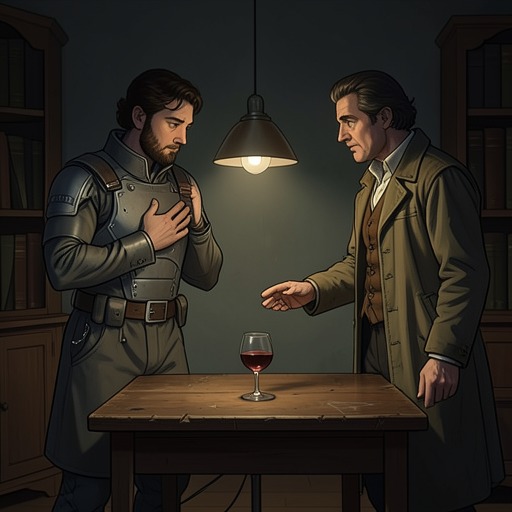
The strongest clue emerges when the wounded Stanton is visited while feverish. He mutters about a doomed ship, the army, and a terrible battle, then cries out for his wife Laura and his son Jack to be saved. The words activate details that had previously seemed separate: Alice had wondered whether Jack's mother was named Laura, and Jack resembles Stanton. Stanton's fever does not by itself constitute complete proof, but it reopens the shipwreck as a shared past rather than merely the origin story of an unidentified child.
Consequences and Significance
Stanton's visit alters the emotional and moral geography of the Ruthven plantation. The Federal camp remains nearby and another battle is expected, yet the household is not treated as enemy property to be stripped. The hospital continues under protection, the wounded are distinguished from combatants, and Alice's fear gives way to a qualified trust grounded in Stanton's behavior. Powell's reunion with Jack supplies a parallel instance of reconciliation: a family relationship survives the uniforms that divide the nation.
The encounter also prepares the resolution of Jack Ruthven's identity mystery. Stanton's shipwreck recollections, his appeal to Laura and Jack, the physical resemblance between the colonel and the youth, the ring and handkerchief retained by Alice, and the recovered tin box form a chain in which memory is repeatedly checked by objects and testimony. Stanton later explains that he survived the wreck, was rescued after more than twenty-four hours, suffered prolonged physical and mental effects, and spent years in an asylum after a physician falsely classified him as incurable. During lucid periods, that physician extracted information about property in England and an estate in Virginia, drugged him, and used the knowledge to pursue Jack and the inheritance.
The recovered papers finally give Stanton the documentary confirmation that memory alone could not provide. Looking over the contents of the tin box, he tells Jack that nothing now stands between them and their fortune. In that sense, the home visit is both a social encounter and a hinge in the novel's evidence structure. Stanton's courtesy resolves one immediate misunderstanding between North and South; his presence at the Ruthven home also allows scattered traces of shipwreck, family, property, and memory to converge until Jack's adopted identity can be understood within a restored biological family without erasing the Ruthven household that raised him.